Your POS system runs in real time. Your CMS processes changes instantly. Your back office is up to date at every moment. But on the shelf edge still hangs last week’s paper label.
That is exactly the spot where customers make their purchase decisions. Not behind a screen and not at the till, but right there in front of the shelf. The gap between what your system knows and what your shelf shows is smaller than you might think, but bigger than you would like.
Electronic shelf labels close that gap. This article explains how they work and what they change in practice.
The gap between your system and your shelf
A promotion goes live at 08:00. The POS system processes the new price immediately. The labels still show yesterday’s information. A staff member walks the aisles, prints, cuts and sticks. By midday most of it is updated.
Meanwhile a customer has picked up a product based on a price that no longer applies. At the till comes the explanation, or the discussion.
This is not an exceptional situation. It is the daily reality in stores that otherwise run fully digitally. Three situations keep coming back: the price on the label differs from what the till charges, a sold-out product still has an active label, or a promotion label remains in place after the end date.
Each case looks small in itself. Together they form a structural problem. The rest of the store environment is going digital: menu boards, ordering screens and POS systems are all connected in real time. The shelf is the only touchpoint that remains dependent on manual work.
Manual work means delay. It means errors caused by human interpretation. And it means your shelf is never fully in sync with what your system knows.
What electronic shelf labels actually change
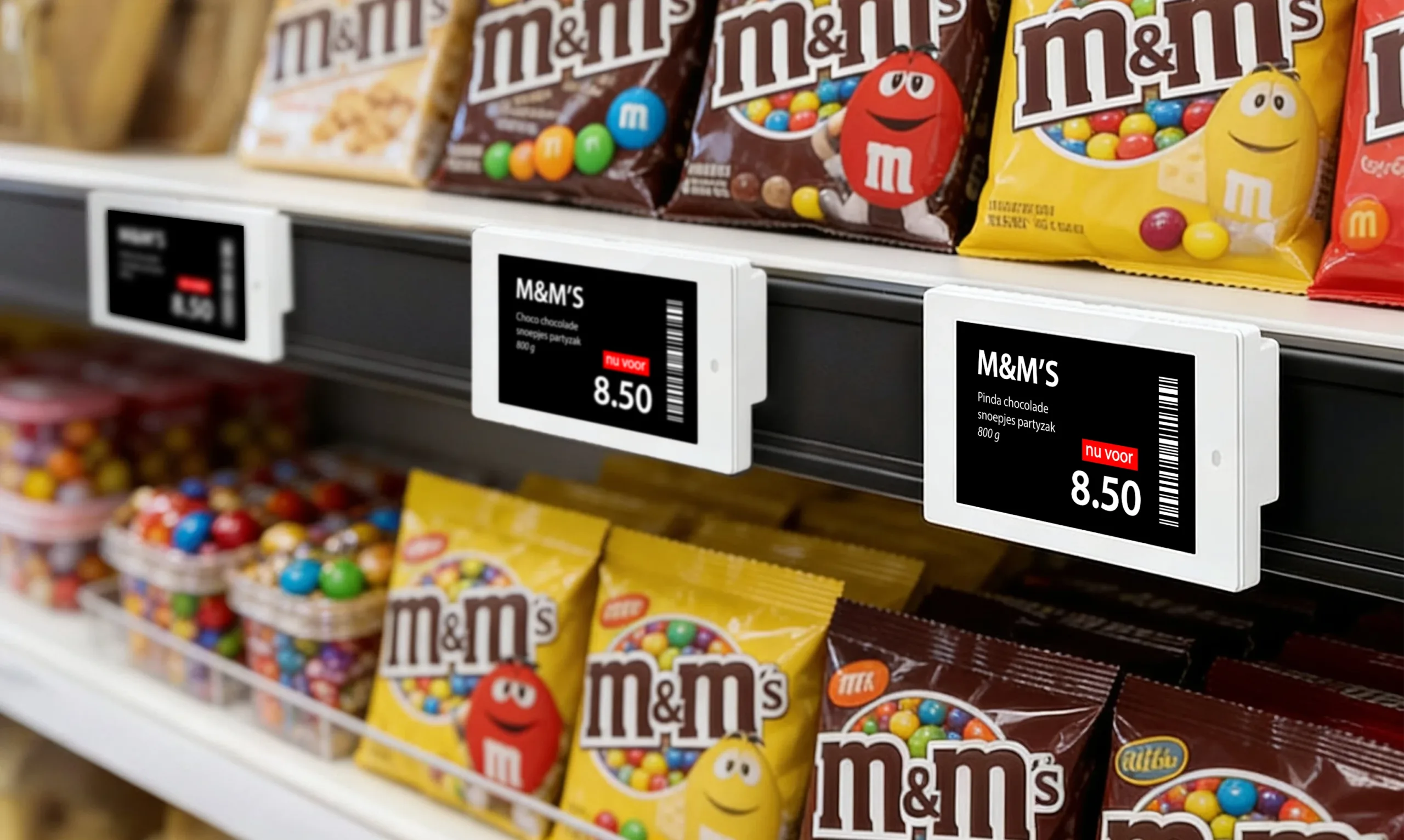
An electronic shelf label, or ESL in industry terms, replaces the paper price label on the shelf edge with a digital e-paper display. The label is controlled wirelessly from the POS system or the back office. A change in the system is visible on every label, in every location simultaneously, within seconds.
This is not a gadget. It is a fundamental change in how a store works. The shelf becomes an active part of the digital infrastructure, instead of a manually maintained add-on.
Real-time updates on every label, in every location
Through a dedicated wireless protocol, updates are sent directly to all labels in the store. A store-wide price change or a new promotion across multiple product groups reaches every label at the same time.
For staff this means: no printing, no walks along the shelves and no errors caused by manual interpretation. The time freed up goes to customer contact and tasks that add direct value on the shop floor.
E-paper only consumes energy when refreshing the display. That makes the technology efficient in use and easy to read in bright light. Both properties are a practical advantage in busy retail locations with varying lighting conditions.
Common sizes range from small labels of about 1.6 inches for standard products to larger formats of 11.6 inches for promotions or product groups. The size depends on the amount of information that needs to be shown per label.
The shelf as an active part of your pricing strategy
Electronic shelf labels enable dynamic pricing on the shelf. A product approaching its expiry date is automatically given a clearance price the moment you set it in the system. A peak-hour rate becomes active at the scheduled time, with no manual action required.
A promotion switches on at exactly the planned moment. Not when a staff member gets around to it, but precisely when the system decides. That gives full control over your pricing strategy, down to the level of the individual label.
The shelf becomes an active part of the digital store experience. Retail experience shows how digital experiences encourage choices in store, from screen to shelf edge.
ESL at petrol and mobility locations
Convenience retail at petrol stations and mobility locations particularly benefits from fast price changes and shelf consistency. The assortment changes, customer dwell time is short and shelf-price errors are immediately visible.
At UNITI Expo 2026 in Stuttgart, Skippify presents ESL publicly for the first time as part of a fully connected retail environment. UNITI Expo is the central platform for the petrol and mobility sector and marks the moment ESL has firmly arrived on the agenda in this sector.
The first roll-out in the Netherlands begins in June 2026, at high-traffic retail locations where the gap between system and shelf is most visible. At those locations shelf consistency is not a side issue but a daily operational priority.
Anyone who wants to understand the broader context of screen solutions in the mobility sector can find additional background through insights on the approach in this sector.
One platform, every touchpoint in sync
ESL runs on the same platform as the rest of the screen infrastructure in the store. A price change in the POS system or back office is visible at the same time on the label, the menu boards and the ordering interface. One source of truth, every touchpoint in sync.
Integration with existing systems is the key to this. Price data does not need to be transferred manually from POS system to shelf label. The connection runs automatically through the central back office that controls all touchpoints simultaneously.
For chains operating across multiple locations this means: a price change at central level is immediately visible on every label, in every store. No delay, no exceptions and no manual action per location.
A solid signage strategy determines which touchpoint shows which message at which moment, so ESL takes its place within the broader screen communication of the store. The strategy connects the shelf with menu boards, ordering screens and all other touchpoints into one coherent whole.
Discover managed signage and schedule a conversation about integrating ESL into your store environment.
Frequently asked questions about electronic shelf labels
What is an electronic shelf label?
An electronic shelf label (ESL) replaces the paper price label on the shelf edge with a digital e-paper display that is controlled wirelessly. The label is updated automatically from the POS system or the back office. That way the price on the shelf is always the same as what the system reports.
How quickly do price changes appear on an electronic shelf label?
Through a dedicated wireless protocol, updates are sent to all labels in the store within seconds. The same applies to store-wide changes where all labels are updated simultaneously. The delay between a system change and what appears on the shelf is therefore practically nil.
What is the difference between e-paper and an LCD screen in a shelf label?
E-paper only consumes energy when refreshing the display and is easy to read in bright light. An LCD screen consumes power continuously and is less suitable for the shelf edge in retail environments. For most retail applications, e-paper is therefore the more practical choice.
How does the communication between the POS system and an electronic shelf label work?
Prices and product information are sent from the POS system or back office through a gateway to a wireless network that controls the labels in the store. The labels receive the data and refresh their display automatically. No manual intervention is required to push through a price change.
When is an electronic shelf label relevant for a retailer?
ESL becomes relevant as soon as price changes occur regularly, multiple locations need to be managed at the same time, or shelf consistency is an operational priority. Even with a small assortment with frequent price movements, automated label processing delivers an immediate time saving. The threshold is lower the more time manual label changes take or the more often they lead to errors.
Are electronic shelf labels also suitable for petrol and mobility locations?
Yes. Convenience retail at petrol stations and mobility locations specifically calls for fast price updates and consistency between system and shelf. These are exactly the properties ESL was designed for. The short dwell time of customers at such locations makes a correct shelf price all the more important.
What are common sizes for electronic shelf labels?
Common sizes range from small labels of about 1.6 inches for standard products to larger formats of 11.6 inches for promotions or product groups. The size depends on the amount of information that needs to be shown per label. Larger sizes are often used for promotions or product groups where more context is desired.
 Jeffrey Brouwer