The decision to pull off at a petrol station is made in seconds. Visibility, recognisability and price determine the choice. The price sign along the road is the first brand touchpoint for motorists, yet it is rarely treated as such. At Tango, the approach is different.
The customer journey begins along the road
A motorist travelling along the motorway at 100 km/h sees the price sign a few seconds before the slip road. In those seconds, they decide whether to pull off. Price, recognisability and legibility are everything. Too late to be seen, too small or too unfamiliar: the car drives on.
Yet at most petrol stations, the price sign is treated as a purely functional object. It displays a number. There is no further communication. The display offers no brand experience, no reason to stop and no reason to come back.
That is a missed opportunity. Treating the sign as a means of communication makes more of the same moment. The motorist sees the price, recognises the brand and notices a promotion or service. They know immediately what to expect before turning onto the forecourt.
At Tango, this principle has guided the design of the entire network of Smart LED price signs.
The challenge: always visible, always current, always on-brand
Tango operates at more than 190 locations across the Netherlands. The brand is known for sharp fuel prices and a growing range of services with EV charging and the Tango app. That combination attracts motorists, but it also sets requirements for how you communicate along the road.
Fuel prices change several times a day. Per location, depending on market conditions and regional factors. Updating more than 190 sites at once by hand is not a realistic scenario. It is too slow, too error-prone and too labour-intensive to sustain.
At the same time, Tango’s ambition reaches further than simply displaying a price. The brand also wants to communicate services and promotions to motorists who have little time. That calls for a system that works automatically, can be controlled centrally and goes beyond a standalone display at each location.
A network of standalone, unconnected screens cannot deliver that. A smartly connected system with central control can.
One screen, every message
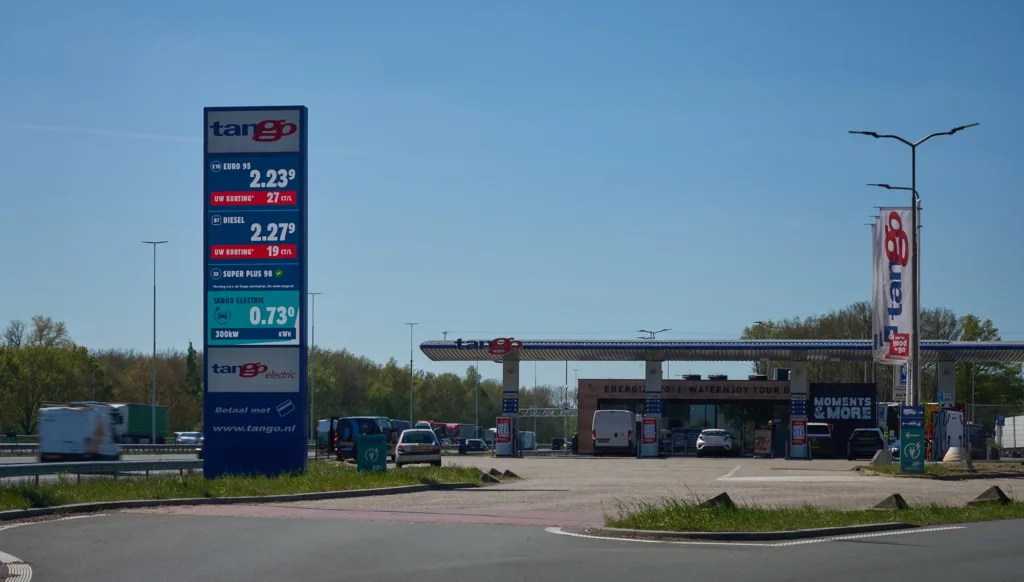
Skippify built a network of Smart LED price signs for Tango with automatic price feeds from the fuel back office. The integration works in real time: a price change in the back office system immediately results in an update on every connected sign. No manual intervention per site, no delay and no risk of outdated information.
The system is designed so that the operator manages the network as a whole, not site by site. That saves time and reduces the risk of errors. Across more than 190 locations simultaneously, that is the difference between a workable and an unworkable process.
The same screen that displays fuel prices also delivers brand campaigns, promotions and service messages. Price and communication come together on one integrated surface. No separate screens, no separate systems, no fragmented management tasks.
Price and campaign on the same screen
The LED screens are clearly legible day and night, even in bright sunlight along busy routes. Their brightness is tuned for outdoor use and for the speed at which motorists need to take in the information.
There is no separate campaign screen next to the price display. A single surface switches dynamically between current price information and brand experience. The system determines when each message appears, based on the content scheduled centrally.
In practice, that means EV charging, discounts and the Tango app appear on the same screen as the current fuel prices. At a glance, the motorist sees what Tango has to offer. No additional structures, no additional hardware, no additional management burden.
The network behind every sign
All of Tango’s Smart LED price signs are managed centrally. Prices, content and campaigns can be controlled per location, per region or across the entire network at once. That flexibility makes it possible to activate a national promotion across every site in a single action, or to show a regional offer only on the relevant screens.
Status monitoring, remote support and content scheduling are integrated into the same platform. If a screen develops a fault, it is flagged immediately. There is no reliance on a local employee to pass the report on. The management team sees the network in real time and can intervene without being on site.
Operators work from a single overview. No separate action per branch, no fragmented management across multiple systems. Everything in one place.
Central management via Skippify Suite
The Tango network is controlled through Skippify Suite. From a single interface, the team manages, monitors and supplies the entire network with price updates and new content.
Managed Signage is designed so the system runs effortlessly: always up to date, always visible and always in line with the brand. Local manual work falls away. The brand experience is consistent at every location, regardless of the size of the network or the distance from head office.
For a network on the scale of Tango, that is not merely an efficiency gain. It is a precondition for being able to communicate consistently across more than a hundred locations at once at all.
A landmark along the A12
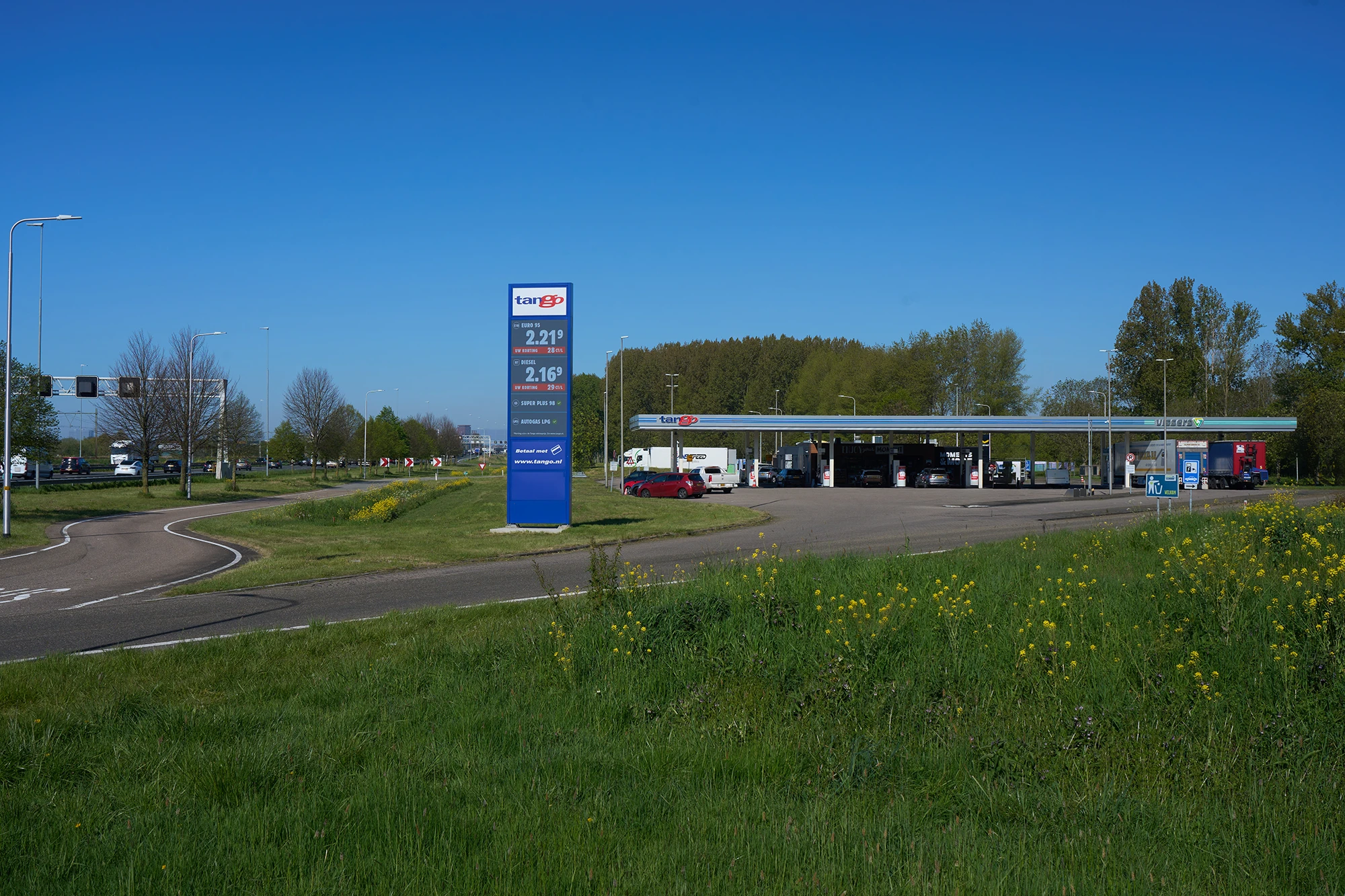
The most visible installation in the Tango network stands at the Knorrestein service area along the A12 near Zoetermeer. It is the largest price totem in the Netherlands: 8 metres tall and 2.20 metres wide, with a large LED screen aimed at motorway traffic in both directions.
On the screen itself: current fuel prices, discounts, LPG, EV charging and the Tango app, all controlled centrally from a single platform. The content rotates automatically based on the schedule set up in Skippify Suite, without any manual intervention on site.
The combination of size, legibility, dynamic content and central control makes Knorrestein a reference point for what a Smart LED price sign can be in a mobility context.
What changes when the price sign becomes smart?
The shift from a static price board to a smartly connected screen brings several direct changes for the operator and for communication with the motorist.
No more outdated prices. The link with the back office makes manual updates unnecessary. Price changes are visible immediately on all connected screens. The risk of errors or delays disappears.
The sign becomes an active means of communication. Promotions, services and brand messages reach the motorist at the moment that matters: just before the slip road. A passive display becomes part of the customer journey.
The network grows without extra operational pressure. Central control keeps scale manageable. More locations do not require a proportional increase in management effort. The platform absorbs the growth.
Every location communicates consistently. Regardless of setting, size or occupancy, the quality of communication is the same everywhere. A site in a provincial town communicates at the same level as a busy motorway stop.
A well-considered signage strategy does not begin with the technology, but with what a customer should see, feel or do at the moment of arrival. For Tango, that answer is now visible at more than 190 locations along every route.
See it live at UNITI Expo 2026
Skippify will be present at UNITI Expo in Stuttgart from 19 to 21 May 2026, in Hall 1, Stand 1E08. UNITI Expo is the international trade fair for the petrol station and mobility retail sector.
At the stand, Skippify will show how Smart LED price signs work as part of a fully connected mobility environment. From the integration with the fuel back office through to content scheduling, status monitoring and central network management, the complete chain can be seen live.
For operators who want to find out what this system could mean for their own network, this is the chance to see it in practice and put questions directly to the people who built and rolled it out.
Book a meeting
Book a meeting at UNITI Expo or arrange a demo at our Experience Centre in Zaltbommel, so you can relate the system to your own situation.
Frequently asked questions about LED price signs
How do Smart LED price signs work?
Smart LED price signs are digital price displays with a clearly legible LED screen that is fed automatically from the fuel back office. Price changes are therefore visible immediately at every connected location, without any manual intervention. The screen is suitable for outdoor use and legible in any light conditions.
How are fuel prices automatically updated on the screens?
Through a direct link between the fuel back office and the management system, price changes are synchronised in real time to every screen in the network. As soon as the price changes in the back office system, the new value appears immediately on the connected signs. No manual intervention per location is required.
Can Smart LED price signs also display campaigns and brand messages?
Yes, the same screen that displays the fuel price can also show promotions, services and brand campaigns. The content is set per location, per region or for the entire network through the central management system. Price and campaign content alternate dynamically on the same screen surface.
What makes the price sign along the A12 near Zoetermeer special?
It is the largest LED price sign in the Netherlands. The sign is 8 metres tall and 2.20 metres wide.
How does a Smart LED price sign differ from a standard price board?
A standard price board displays a static price that is updated by hand, which becomes unworkable across multiple locations and frequent price changes. A Smart LED price sign is connected to the back office and updates automatically as soon as the price changes. In addition, the same screen can show dynamic campaign content, which is not possible with a static board.
 Skippify